 Phone: 0731-3121900, Mob: 9229297668, 9826655552
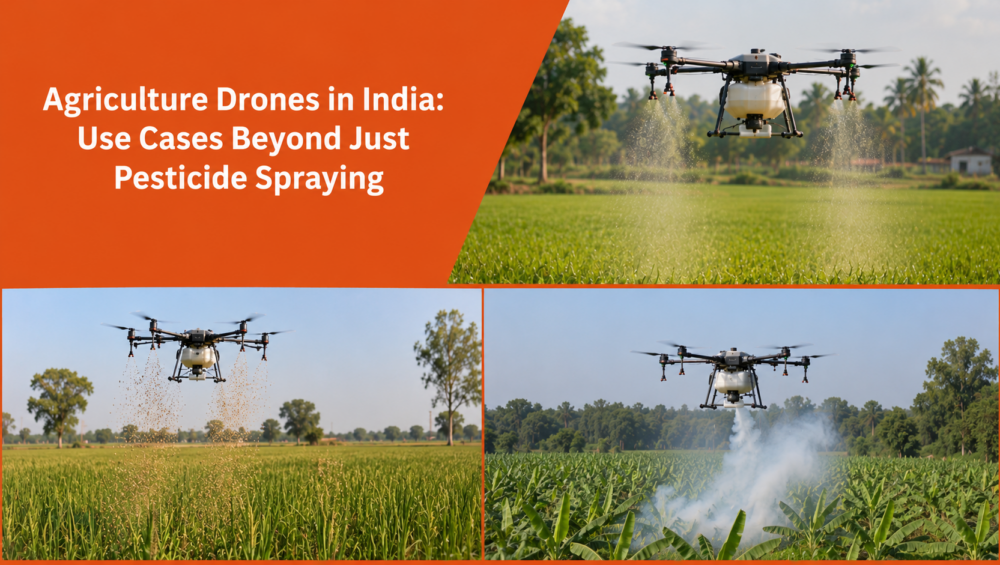
For decades, Indian agriculture was defined by hard manual labor, unpredictable weather, and traditional farming methods passed down through generations. But in 2026, a quiet technological revolution is reshaping the fields of India. From Punjab to Maharashtra and Andhra Pradesh, the buzzing sound of drones has become increasingly common in rural landscapes.
While most people associate drones with pesticide spraying, the role of modern agricultural drones goes far beyond that. Today, drones are becoming intelligent farming companions that help farmers monitor crops, manage water, reduce input costs, and make data-driven decisions.
The rise of agriculture drones in India is transforming how farmers approach cultivation, irrigation, and crop management. India’s drone ecosystem has grown rapidly in recent years, with thousands of registered drones and DGCA-certified pilots contributing to the modernization of farming practices. The focus is no longer just on automation it is now about precision agriculture and smarter farming.
The Role of Crop Monitoring Drones in Shaping the Future of Indian Agriculture
One of the most impactful developments in modern agriculture is the use of crop monitoring drones. Traditionally, farmers had to physically walk across large fields to identify pest attacks, nutrient deficiencies, or water stress. This process was time-consuming and often ineffective because early-stage problems were difficult to detect with the naked eye.
Today, drones equipped with multispectral and hyperspectral sensors can capture detailed aerial data that reveals crop health conditions before visible symptoms appear. These drones use NDVI (Normalized Difference Vegetation Index) technology to identify stressed plants, nutrient-deficient zones, and uneven crop growth patterns.
This allows farmers to take corrective action at the right time, improving both productivity and crop quality.
Key Use Cases of Agriculture Drones Beyond Spraying
1. Precision Nutrient Management
Modern farming is shifting from blanket fertilizer application to targeted nutrient management. Drones can identify areas where crops require additional nutrients and apply fertilizers only where needed.
This precision approach reduces fertilizer wastage, lowers farming costs, and minimizes environmental damage. Nano-fertilizer spraying through drones is becoming increasingly popular among progressive farmers because it improves nutrient absorption while reducing excessive chemical use.
Studies indicate that precision drone application can significantly reduce fertilizer consumption while improving overall crop performance.
2. Irrigation and Water Stress Detection
Water scarcity remains one of the biggest challenges for Indian agriculture. Climate change and irregular monsoon patterns have made efficient water management essential for survival.
Drones fitted with thermal imaging cameras can detect water-stressed areas within fields by identifying temperature variations. Well-irrigated sections appear cooler, while dry or stressed zones appear hotter.
This helps farmers optimize irrigation schedules, prevent overwatering, and conserve precious groundwater resources. Accurate irrigation management also reduces the risk of crop diseases caused by excess moisture.
3. Disaster Assessment and Crop Insurance
Unseasonal rains, floods, hailstorms, and droughts often cause severe crop damage in India. Traditionally, insurance assessments took weeks due to manual inspections, delaying compensation for farmers.
Now, drones are being used for rapid aerial surveys under schemes like PMFBY (Pradhan Mantri Fasal Bima Yojana). High-resolution drone imagery helps authorities assess crop losses quickly and accurately.
This technology speeds up insurance claim processing and ensures greater transparency in compensation systems, offering farmers faster financial relief during crises.
4. Digital Crop Survey and Land Mapping
India’s Digital Agriculture Mission and AgriStack initiatives are heavily relying on drone technology for land mapping and crop surveys.
Drones help create accurate digital records of farmland boundaries, crop types, and sowing patterns. This improves land documentation and simplifies access to agricultural loans, subsidies, and government support schemes.
Accurate digital mapping also helps policymakers make better decisions related to food production, water management, and rural development.
5. Seed Broadcasting and Plantation Support
Another emerging use of drones is aerial seed broadcasting. In difficult terrains or large-scale plantations, drones can disperse seeds quickly and uniformly.
This technique is especially useful in reforestation projects, cover cropping, and paddy farming. It reduces labor dependency and speeds up plantation activities significantly.
The Social Revolution: The Impact of the Namo Drone Didi Scheme
The drone revolution in India is not just technological — it is also social and economic.
The government-backed Namo Drone Didi initiative is empowering women from Self-Help Groups (SHGs) to become trained drone pilots and service providers. These women are now offering drone-based agricultural services to farmers in their villages.
This shift is creating a new rural economy centered around technology-driven entrepreneurship. Instead of depending solely on manual farm labor, rural communities are embracing skilled technical services through Drone-as-a-Service (DaaS) models.
The initiative is also encouraging youth participation in agriculture by making farming more technology-oriented and financially attractive.
The Growing Role of Drone Technology Companies
The rapid adoption of drones has also fueled the growth of several agriculture drone companies in india that are developing advanced solutions for crop monitoring, spraying, mapping, and farm analytics.
These companies are focusing on affordable drone systems, AI-powered crop intelligence, and scalable Drone-as-a-Service platforms that cater specifically to Indian farming conditions.
Alongside monitoring technology, the demand for the drone spray machine is also increasing rapidly among farmers looking for efficient, time-saving, and precision-based spraying solutions.
Challenges Still Exist
Despite rapid growth, certain obstacles continue to slow large-scale adoption.
High-end monitoring drones remain expensive for small and marginal farmers. Limited awareness, training gaps, and infrastructure challenges also affect implementation in remote regions.
However, government support, reduced GST rates on drones, subsidy programs, and the expansion of pilot training centers are gradually making drone technology more affordable and accessible.
As drone manufacturing increases domestically, costs are expected to decline further in the coming years.
The Future of Intelligent Farming in India
The future of Indian agriculture is moving toward intelligence-led farming, where real-time data guides every farming decision.
With the integration of AI, IoT, and drone analytics, farmers will soon receive automated recommendations for irrigation, fertilization, disease management, and yield prediction.
The role of drones is no longer limited to spraying chemicals. They are becoming essential tools for precision farming, sustainability, and rural transformation.
As India continues its journey toward a digitally empowered agricultural ecosystem, drones will play a major role in ensuring higher productivity, improved profitability, and long-term food security for the nation.
The era of smart farming has already begun — and agriculture drones are leading the way.
FAQ
1. What are the main uses of agriculture drones in India besides pesticide spraying?
Beyond spraying pesticides, agriculture drones in india are widely used for crop monitoring, irrigation analysis, precision fertilizer application, land mapping, seed broadcasting, and disaster assessment. These drones help farmers improve productivity while reducing input costs and water wastage.
2. How do drone spray machines help farmers increase efficiency?
A drone spray machine allows farmers to spray fertilizers and pesticides quickly and evenly across large farmland areas. It reduces manual labor, saves time, minimizes chemical exposure for workers, and ensures precise application, leading to healthier crops and better yields.
3. Which are the leading agriculture drone companies in India?
Several agriculture drone companies in india are developing advanced farming solutions for precision agriculture, crop analytics, and smart spraying systems. These companies are helping farmers adopt modern technology through affordable drones, training programs, and Drone-as-a-Service (DaaS) models.