 Phone: 0731-3121900, Mob: 9229297668, 9826655552
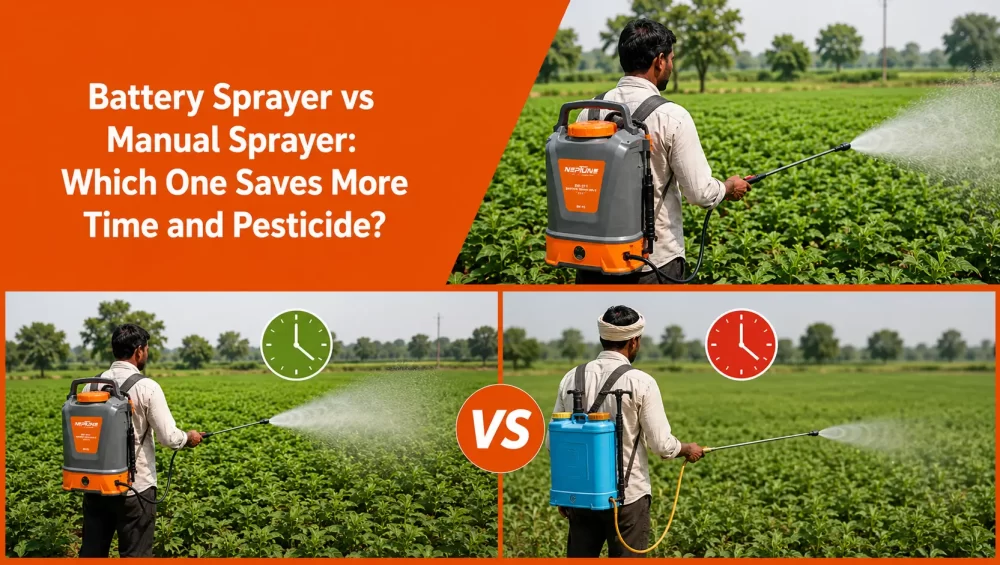
For farmers, gardeners, and pest control professionals, choosing the right spraying equipment can significantly impact productivity, crop health, and operational costs. When it comes to applying pesticides, herbicides, or liquid fertilizers, the choice often comes down to two options: the traditional manual sprayer and the modern battery-powered sprayer.
Manual sprayers have been trusted by farmers for decades due to their affordability and simplicity. However, battery sprayers are becoming increasingly popular because of their efficiency, ease of use, and ability to deliver consistent results. But which one actually saves more time and pesticide? Let’s find out.
Understanding the Difference
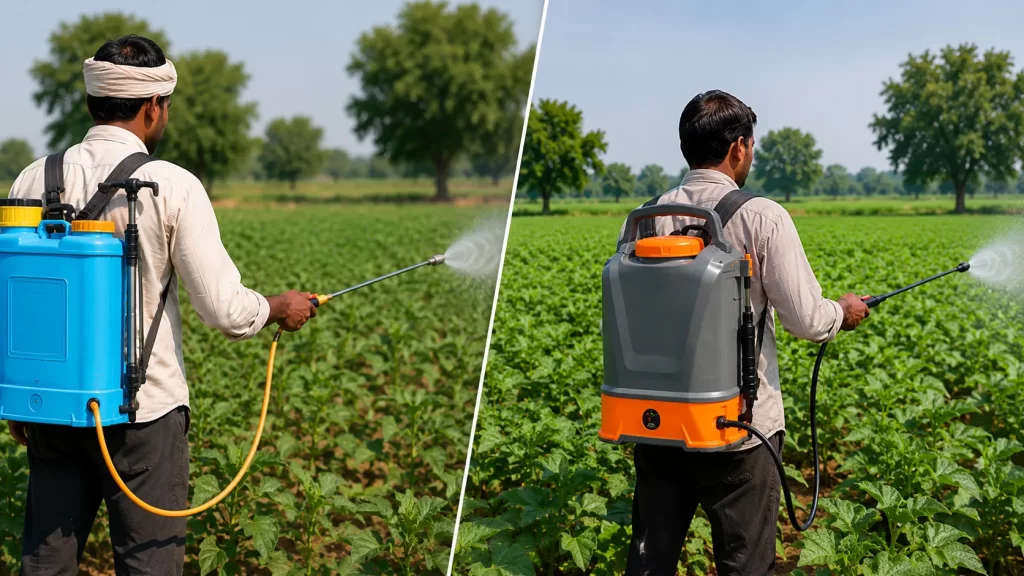
A manual sprayer relies on continuous hand pumping to create pressure inside the tank. The operator must regularly stop and pump to maintain the spray flow.
A battery sprayer, on the other hand, uses an electric motor powered by a rechargeable battery. With the push of a button, the sprayer maintains a steady pressure throughout the spraying operation without any manual effort.
Time Efficiency: Which One Works Faster Manual Sprayers or Battery Sprayers?
Manual Sprayers
Using a manual sprayer requires constant pumping while walking through the field. This repetitive task can become tiring, especially during large-scale spraying operations. As fatigue increases, the spraying speed naturally decreases, leading to longer working hours.
Battery Sprayers
Battery-powered sprayers eliminate the need for manual pumping. Since the motor automatically maintains pressure, operators can focus entirely on spraying and covering the target area efficiently. The steady operation allows for faster movement across fields and fewer interruptions.
Winner: Battery Sprayer
A battery sprayer can help farmers cover the same area up to 3–4 times faster than a manual sprayer, making it an excellent choice for large farms and commercial applications.
Pesticide Efficiency: Which One Reduces Wastage?
The biggest factor affecting pesticide consumption is spray pressure.
Manual Sprayers
Pressure inside a manual sprayer constantly fluctuates depending on how frequently and forcefully the operator pumps. These variations create inconsistent spray patterns.
This often leads to:
- Overspraying in some areas
- Underspraying in others
- Uneven pest control
- Increased chemical wastage
Battery Sprayers
Battery sprayers provide regulated and consistent pressure throughout the spraying process. This ensures a uniform flow rate and even distribution of chemicals across crops.
As a result:
- Every plant receives the correct dosage.
- Coverage is more uniform.
- Less pesticide is wasted.
- Crop protection becomes more effective.
Winner: Battery Sprayer
Consistent pressure helps reduce chemical consumption while improving spraying accuracy.
How Spray Pressure Impacts Chemical Usage
Spray pressure directly affects droplet size, coverage, and pesticide efficiency.
Low Pressure: The Hidden Cause of Chemical Waste
When pressure drops, which commonly happens with manual sprayers, the liquid exits the nozzle as larger droplets instead of a fine mist.
Consequences include:
- Droplets rolling off leaves
- Poor coverage of plant surfaces
- Increased chemical runoff into the soil
- Reduced effectiveness against pests and diseases
Large droplets may appear to use more pesticide, but much of it never reaches the target area effectively.
Consistent Pressure: The Key to Better Coverage
Battery sprayers maintain a steady pressure level that produces fine, uniform droplets.
Benefits include:
- Better leaf coverage
- Improved penetration into dense crops
- Enhanced pesticide effectiveness
- Reduced chemical wastage
Many farmers report savings of up to 20–30% in pesticide usage due to more efficient atomization and application.
Avoiding Excessively High Pressure
While consistent pressure is beneficial, excessively high pressure can create ultra-fine droplets that drift away with the wind.
Modern battery sprayers often feature adjustable pressure controls, allowing users to maintain the ideal pressure range for maximum efficiency and minimum drift.
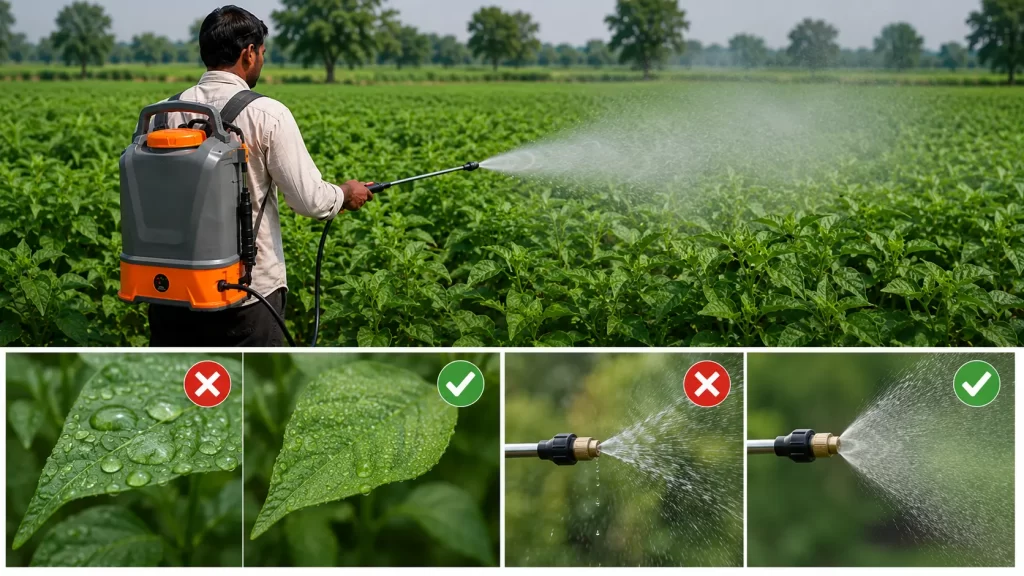
How Spray Pressure Affects Chemical Consumption and Coverage
| Feature | Manual Sprayer | Battery Sprayer |
| Operation | Continuous hand pumping | Electric motor operation |
| Pressure Consistency | Variable and uneven | Constant and regulated |
| Spray Coverage | Inconsistent | Uniform |
| Chemical Efficiency | Lower | Higher |
| Physical Effort | High | Low |
| Productivity | Moderate | High |
| User Fatigue | Significant | Minimal |
| Suitability for Large Farms | Limited | Excellent |
Additional Benefits of Battery Sprayers
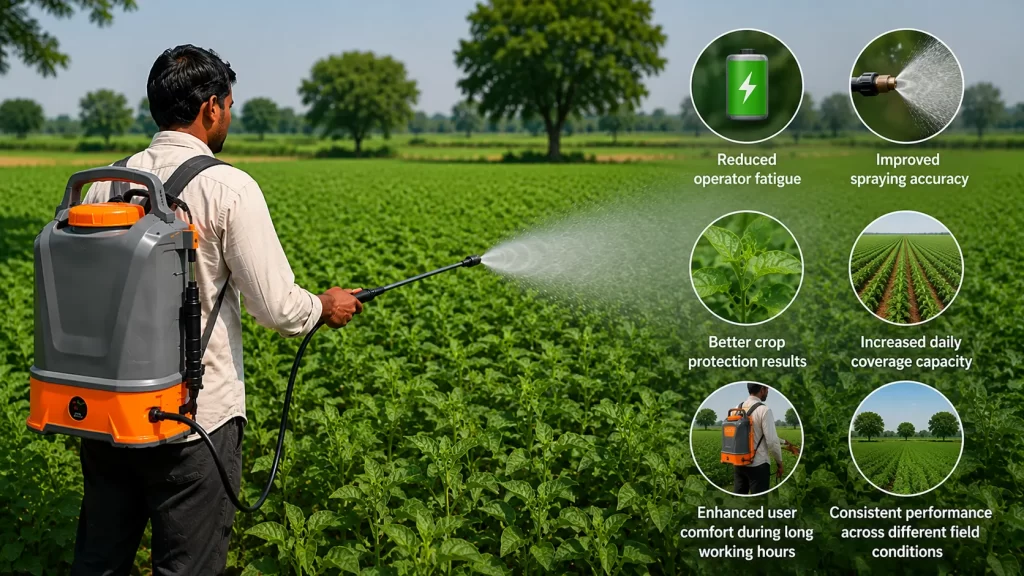
Apart from saving time and pesticides, battery sprayers offer several additional advantages:
- Reduced operator fatigue
- Improved spraying accuracy
- Better crop protection results
- Increased daily coverage capacity
- Enhanced user comfort during long working hours
- Consistent performance across different field conditions
These benefits make battery sprayers a preferred choice for modern agricultural operations.
Conclusion
While manual sprayers remain a budget-friendly option for small gardens and occasional use, they often lead to greater chemical wastage, uneven application, and increased labor requirements.
Battery sprayers offer a smarter and more efficient solution. By maintaining consistent spray pressure, they ensure optimal droplet formation, superior coverage, and significant savings in pesticide consumption. Combined with faster field coverage and reduced physical effort, battery sprayers provide excellent long-term value for farmers and agricultural professionals.
If your goal is to save time, reduce pesticide costs, and improve crop protection, a battery sprayer is undoubtedly the better investment.
FAQs
1. Does a battery sprayer really save pesticide?
Yes. A battery sprayer provides consistent pressure and uniform droplet size, which can reduce pesticide wastage by up to 20–30% compared to manual spraying.
2. Which is better for large farms: manual or battery sprayer?
Battery sprayers are ideal for large farms because they cover more area in less time and require significantly less physical effort.
3. How long does a battery sprayer run on a single charge?
Most battery sprayers can operate continuously for 4–8 hours on a full charge, depending on the battery capacity and spraying pressure.