 Phone: 0731-3121900, Mob: 9229297668, 9826655552
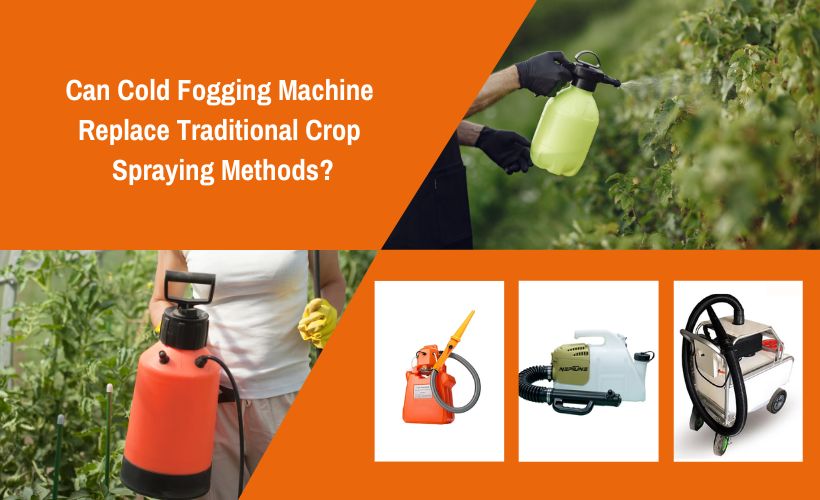
For generations, the image of tractors trudging through fields, spraying crops with pesticides and fertilizers, has been a staple of modern agriculture. This traditional crop spraying method, while effective, has long presented challenges related to efficiency, resource use, and environmental impact.
But what if there were a better way, one that’s both efficient and environmentally conscious? Enter the cold fogging machine, a technique that’s been gaining momentum in agricultural circles for its potential to revolutionize crop care. The big question: Can cold fogging truly replace traditional spraying?
Let’s dive into both methods to find out.
Understanding the Methods: A Tale of Two Approaches
Traditional crop spraying involves mixing agricultural chemicals with large volumes of water and spraying the solution using hydraulic nozzles. The resulting droplets are relatively large and designed to cover plant surfaces directly. While it provides decent coverage, this approach often results in chemical drift, runoff, and uneven distribution, leading to wasted resources and potential environmental harm.
Cold fogging uses specialized equipment such as a cold fogger machine or cold fogging machine to atomize liquids into ultra-fine droplets—typically between 5 to 50 microns—via air shear or ultrasonic nozzles. These micro-droplets remain suspended in the air longer, allowing them to settle evenly across all parts of the plant, including the undersides of leaves and tight crevices that are hard to reach with traditional methods.
The Allure of Cold Fogging: Advantages That Spark Interest
Cold fogging presents several compelling advantages:
- The fine mist thoroughly envelops the plant canopy, ensuring uniform distribution. The smaller droplets adhere well to plant surfaces, reducing runoff and increasing effectiveness.
- Improved coverage often means you need less pesticide or fertilizer to achieve the same result. This leads to cost savings and reduced environmental impact.
- Cold fogging uses minimal or no water, especially in ultra-low volume applications, making it suitable for water-scarce areas.
- Fogging systems like the fogging machine India can cover large areas quickly, saving time and labor. Plus, the mist dries faster, reducing the risk of wash-off.
- With better control over droplet size and direction, cold fogging minimizes the impact on non-target organisms and nearby crops.
- Cold fogging excels in greenhouses, net houses, and poly tunnels where airflow helps distribute the fog evenly.
The Challenges and Considerations: Why Traditional Methods Still Hold Ground
Despite its benefits, cold fogging isn’t a one-size-fits-all solution:
- The initial investment in equipment like a cold fogger machine can be high, making it less accessible to small-scale farmers.
- In open fields, wind can disrupt the uniform distribution of the fine mist produced by a cold fogging machine, affecting its efficiency.
- Some systemic treatments require more carrier volume, making traditional spraying more suitable in those cases.
- Operating fogging equipment demands proper training and expertise to ensure safety and effectiveness.
- For very large farms, traditional spraying methods might still be more practical and cost-effective.
Cold fogging offers significant advantages in terms of precision, chemical savings, and water conservation. However, the cost of equipment, wind sensitivity, and specific treatment requirements mean that traditional spraying remains relevant.
The Verdict: A Complementary Approach, Not a Complete Replacement—Yet
As technology evolves and prices for devices like the fogging machine in India potentially drop, adoption is likely to increase, especially in controlled environments and specialty crops.
The future of crop spraying may not be a matter of choosing one method over the other. Instead, farmers can combine techniques—leveraging the benefits of both cold fogging and traditional spraying—based on crop type, field conditions, and goals.
FAQ
Q1. What chemical is used for fogging?
Pyrethroids, derived from chrysanthemum flowers, are popular for their ability to quickly knock down insects while remaining effective for extended periods. Common pyrethroids used in thermal fogging include permethrin and lambda-cyhalothrin.
Q2. What does fogging do?
Fogging is a technique used for killing insects that involves using a fine pesticide spray (aerosol), which is directed by a blower. In some cases, a hot vapour may be used to carry the spray and keep it airborne for longer. Fast-acting pesticides like pyrethroids are typically used.