 Phone: 0731-3121900, Mob: 9229297668, 9826655552

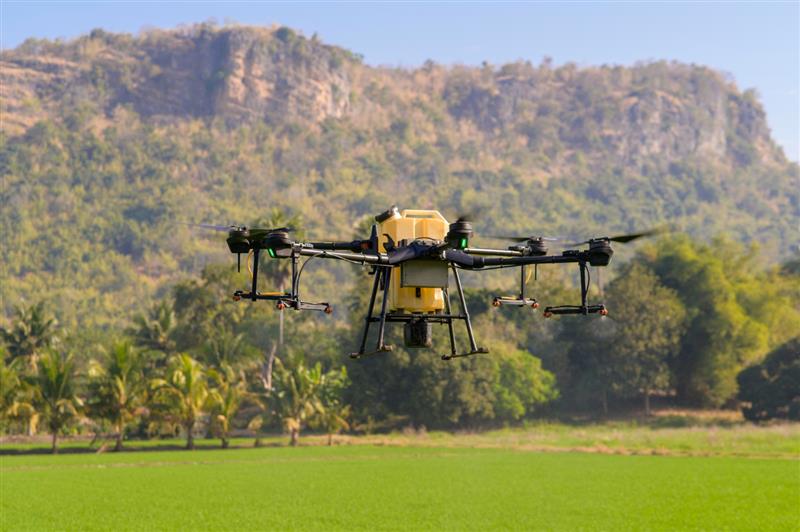
Modern agricultural technology is rapidly advancing, and the performance of an agriculture spraying drone depends on several specialized components. Each part is responsible for maintaining flight stability, ensuring accurate pesticide delivery, and supporting safe operations.
1. Flight Controllers – The Brain of the Drone
The Flight Controller Unit (FCU) acts as the central computer. It collects and processes data from GPS, gyroscopes, and accelerometers to:
- Maintain stable flight
- Enable autonomous operations
- Execute pre-programmed missions
- Adjust altitude using radar-based terrain-following
Advanced FCUs help the Drone Machine maintain a safe and constant height over varying crop canopies.
2. High-Capacity Batteries – The Powerhouse
Agricultural drones carry heavy liquid payloads ranging from 10–30 liters. This requires powerful, high-density battery packs such as:
- Lithium Polymer (LiPo)
- Lithium-ion (Li-ion)
Most models use 6S or 12S batteries to generate the required thrust and endurance for long flights.
3. Precision Nozzles – The Spray Delivery System
Nozzles determine spray quality and droplet uniformity. Common types include:
- Low-drift nozzles
- Centrifugal nozzles
- Flat-fan nozzles
They typically generate droplets between 250–350 μm, reducing drift and improving spray deposition.
4. Core Sensors & Navigation Technologies
RTK/PPK GPS Modules
These systems provide centimeter-level accuracy for:
- Perfect flight line execution
- Eliminating overlaps
- Ensuring complete field coverage
Obstacle-Avoidance Radar
These sensors detect obstacles like trees, power lines, and buildings, enabling safer and more reliable operations.
Agriculture Drone Sprayer: Benefits, Costs, and Subsidies for Indian Farmers
The adoption of agriculture drones in India is rising due to their efficiency, cost savings, and government support.
Key Benefits
| Benefit | Description | Impact |
| Precision Application | GPS-based targeted spraying | Reduces chemical use by 30–40% |
| High Speed & Efficiency | Covers 1 acre in 5–10 mins | Saves time during pest outbreaks |
| Safety & Health | Eliminates operator exposure | Safer for farmers |
| Works on Difficult Terrain | Functions in muddy/uneven fields | Prevents soil compaction |
Cost of Drone Sprayers in India
A medium-sized drone spray machine (10–25L) typically costs ₹4 lakh to ₹10 lakh.
Government Subsidies (SMAM & NaMo Drone Didi)
| Beneficiary | Subsidy % | Limit |
| SC/ST, Women, Small/Marginal Farmers, NE States | 50% | Up to ₹5 lakh |
| Other Farmers | 40% | Up to ₹4 lakh |
| FPOs/CHCs/Cooperatives | 40% | Up to ₹4 lakh |
| Women SHGs (Drone Didi) | 80% | Up to ₹8 lakh |
| ICAR/KVKs/SAUs (Demo) | 100% | Up to ₹10 lakh |
Drone Spraying Requirements and Regulations Guide (Sensors, RTK, Nozzles)
Drone pesticide application in India is governed by Drone Rules 2021 and Ministry of Agriculture SOPs.
1. Pilot & Drone Certification
- Drone must have a UIN
- Must be DGCA Type Certified
- Operator must hold an RPC
2. Airspace Compliance
Use Digital Sky Platform before every flight.
Most agricultural land lies in Green Zones, allowing flight up to 400 ft.
3. Precision Technology Requirements
- RTK GPS mandatory for accuracy
- Calibrated nozzles with approved droplet size
- Only CIB&RC-approved pesticides allowed
4. Operational Standards
- Flight Speed: 3.5–5.0 m/s
- Spray Height: 1.5–2.5 meters
- Avoid spraying when wind > 3 m/s or temperatures are too high
Using Drones for Precision Pest Management in Horticulture
For horticultural crops like orchards, vineyards, and vegetables, drones provide precision-driven pest management.
1. Early Detection with Advanced Sensors
Multispectral or hyperspectral cameras detect:
- Disease
- Pest activity
- Nutrient stress
Even before symptoms appear.
2. Prescription Mapping (VRT Technology)
Sensor data is converted into:
- Crop health maps
- Variable Rate Technology (VRT) spray maps
- Zone-wise chemical dosage recommendations
3. Targeted Spot Spraying
RTK-enabled drones spray only affected zones, resulting in:
- Reduced pesticide usage
- Cleaner, safer produce
- Higher-quality harvest
FAQ
1. What is the cost of an agriculture spraying drone in India?
The price of an agriculture spraying drone in India typically ranges from ₹4 lakh to ₹10 lakh, depending on the payload capacity (10L–25L), battery type, flight time, and brand. Government schemes like SMAM and NaMo Drone Didi also offer subsidies of 40% to 80%, reducing the total cost significantly for eligible farmers.
2. How many acres can a drone spray in one day?
A standard 10–20L agricultural spraying drone can spray 20 to 30 acres per day on average. Under ideal conditions, one acre can be sprayed in 5–10 minutes, making drones highly efficient during peak pest or disease outbreaks.
3. Is a license or certification required to operate an agriculture drone?
Yes. As per DGCA Drone Rules 2021, operators must have a Remote Pilot Certificate (RPC) from a DGCA-approved training institute. The drone must also be Type Certified and assigned a Unique Identification Number (UIN) before commercial use such as spraying.