 Phone: 0731-3121900, Mob: 9229297668, 9826655552

Mechanization in farming is no longer a luxury—it’s a necessity. For crops like paddy, harvesting by hand takes too much time, effort, and cost. This is where the paddy reaper machine comes in. It helps farmers harvest their crops faster, reduces manual labor, and cuts down expenses. Let’s explore the types, main components, and working principles of these machines.
Types of Paddy Reaper Machines
- Manual Paddy Reaper
- Affordable and easy to handle.
- Suitable for small fields.
- Works best where labor costs are high and machinery access is limited.
- Affordable and easy to handle.
- Power Reaper Machine
- Runs on fuel or electricity.
- Designed for medium to large farms.
- Can harvest wheat, paddy, and other grains quickly.
- Average reaper machine price depends on capacity and brand.
- Runs on fuel or electricity.
- Self-Propelled Paddy Reaper
- Comes with its own driving mechanism.
- Allows farmers to walk behind or ride along.
- Highly efficient for Indian farms larger than 1 acre.
- Comes with its own driving mechanism.
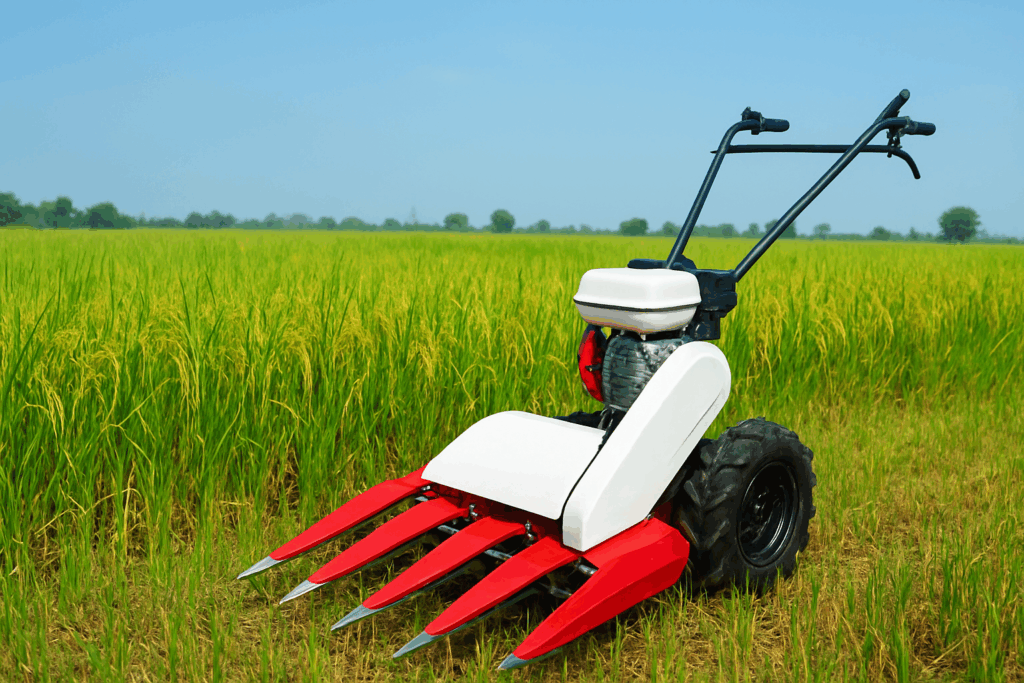
Components of a Paddy Reaper
A typical paddy harvester machine is made up of these essential parts:
- Cutting Blades – Sharp blades that cut the standing crop close to the ground.
- Cutter Bar – The bar that holds and supports blades.
- Engine/Motor – Provides the power to run the machine.
- Transmission System – Transfers engine power to the blades and wheels.
- Handlebars/Controls – Allow farmers to maneuver the reaper.
- Wheels or Tracks – Help in mobility across paddy fields.
Working Principle of a Paddy Reaper
The principle is simple yet effective:
- The blades cut the standing crop (paddy, wheat, barley).
- The reaper lays the crop neatly in rows, making it easy to collect and bundle.
- The machine is powered by either manual effort (in small reapers) or an engine (in power/self-propelled reapers).
By reducing manual work, it allows one person to complete what normally takes 8–10 people in the field.
भारत का सबसे सस्ते दामों में दमदार Power Reaper | 1 एकड़ में खर्च ₹100
For Indian farmers, cost is a big concern. The good news is, today’s power reaper machines are available at very affordable prices. A good paddy reaper price starts at just a few thousand rupees and can save massive labor costs.
Imagine this: with a power reaper, the cost of harvesting 1 acre of land can be as low as ₹100. Compare that to traditional manual harvesting, which can cost 5–6 times more in labor. This makes the power reaper machine one of the smartest investments for Indian farmers.
Best Practices of Using a Paddy Harvester Machine: Tips and Tricks for Indian Farmers
To get the best output and long life from your machine, follow these tips:
- Regular Maintenance – Clean the blades after every use and check the engine oil regularly.
- Sharp Blades = Faster Cutting – Replace or sharpen blades when needed to ensure smooth cutting.
- Adjust for Crop Type – Set cutting height depending on whether you are harvesting wheat, barley, or paddy.
- Use in Dry Fields – Avoid using the reaper in overly muddy fields to prevent damage.
- Train Before Heavy Use – Beginners should start in smaller plots before handling bigger fields.
Final Thoughts
The paddy reaper machine is a game-changer for Indian farmers. It reduces cost, saves time, and increases efficiency. Whether you choose a manual reaper for a small plot or a power reaper machine for larger fields, it’s an investment that pays for itself quickly.
If you’re planning to buy one, compare the reaper machine price options, check after-sales service, and go for a brand that suits your budget and farm size.
With the right machine, harvesting paddy doesn’t have to be back-breaking—it can be fast, affordable, and highly productive.
FAQs on Paddy Reaper Machines
Q1. What is the average paddy reaper price in India?
The paddy reaper price in India usually ranges between ₹35,000 to ₹1,50,000 depending on the brand, engine power, and features. Basic manual models are cheaper, while power reapers and self-propelled machines cost more.
Q2. Which is better for Indian farmers: manual or power reaper machine?
For small farms under 1 acre, a manual paddy reaper can be sufficient. For larger fields, a power reaper machine is more efficient as it saves both time and labor costs.
Q3. How much does it cost to harvest 1 acre of paddy with a power reaper?
With a power reaper machine, the harvesting cost is as low as ₹100 per acre, making it far more economical compared to manual labor.
Q4. Can a paddy harvester machine also cut wheat and barley?
Yes, most paddy harvester machines are multi-purpose. They can harvest wheat, barley, and similar crops with the same efficiency.
Q5. What should farmers check before buying a paddy reaper?
Before purchasing, check the reaper machine price, availability of spare parts, after-sales service, cutting width, and fuel efficiency.
Q6. How long does a paddy reaper last?
With proper maintenance, a good paddy reaper machine can last 7–10 years. Regular servicing and blade replacement are key to extending its life.
Q7. Is subsidy available on paddy reaper machines in India?
Yes, the Indian government provides subsidies under various agricultural schemes. Farmers can get 40–60% off the actual paddy reaper price, depending on the state and scheme.