 Phone: 0731-3121900, Mob: 9229297668, 9826655552
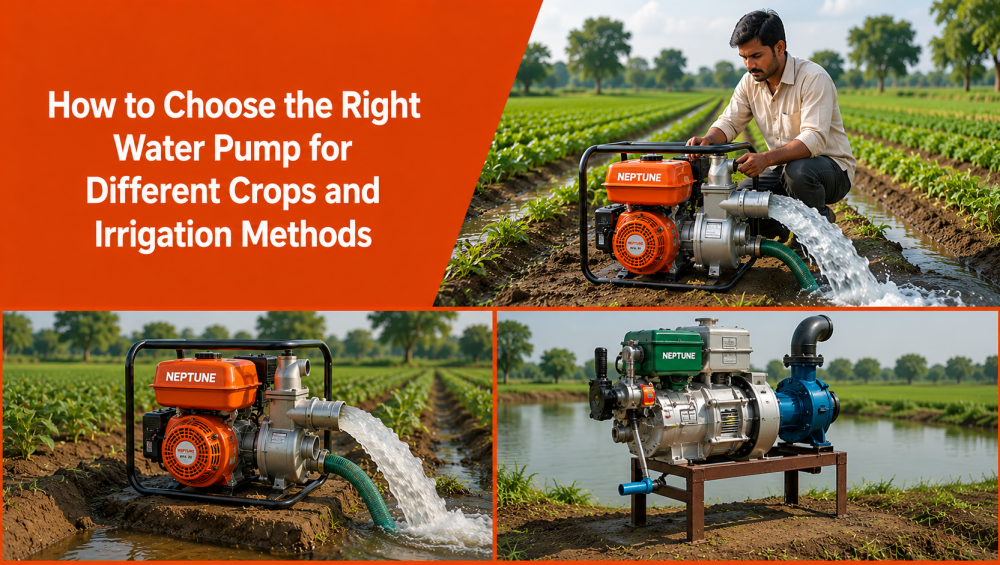
Water is one of the most important resources in agriculture, but delivering it efficiently to the field requires more than simply having a reliable water source. The right pump can influence irrigation performance, energy consumption, operating costs, and overall farm productivity.
Choosing an unsuitable pump can result in insufficient water flow, uneven irrigation, excessive electricity or fuel consumption, and frequent maintenance problems. The ideal pump depends on factors such as water source, crop type, irrigation method, required discharge, and total pumping head.
In this guide, we explain how to select the right pump for different crops and irrigation systems.
3 Critical Factors to Consider Before Selecting a Water Pump
Before purchasing an agriculture water pump, it is important to understand your farm’s specific irrigation requirements.
1. Water Source and Depth
The water source plays a major role in determining the type of pump required.
Deep borewells generally require submersible pumps designed to operate below the water level. For shallow wells, ponds, canals, and other surface water sources, surface centrifugal or open-well pumps may be more appropriate.
You should also consider the vertical distance between the water source and the field, along with the horizontal distance the water needs to travel.
2. Required Flow Rate
Flow rate refers to the quantity of water a pump can deliver within a specific period. It is commonly measured in litres per minute (LPM), litres per second (LPS), or cubic metres per hour.
Your required flow rate depends on:
- Cultivated area
- Crop water requirements
- Irrigation method
- Number of sprinklers or drip lines
- Irrigation schedule
- Available water supply
A pump with insufficient discharge may not provide enough water to the entire field, while an oversized pump can consume unnecessary energy.
3. Total Dynamic Head
Total Dynamic Head (TDH) represents the total resistance that a pump must overcome to move water through an irrigation system.
It includes the vertical lifting height as well as pressure losses caused by pipes, bends, valves, filters, and other components.
For example, a pump lifting water from a deep borewell to a field at a higher elevation requires greater head capacity than a pump moving water across a short, level distance.
Matching Water Pumps With Different Irrigation Methods
Different irrigation systems have different pressure and flow requirements. Matching the pump to the delivery method can improve irrigation efficiency and water distribution.
1. Drip Irrigation
Drip irrigation delivers water directly to the root zone through emitters and distribution lines. Since the system uses small outlets, maintaining suitable and consistent pressure is important.
Suitable Pump Types: Centrifugal surface pumps, monoblock pumps, or appropriately sized submersible pumps.
Key Requirement: Consistent pressure and controlled flow for effective operation of filters, pipes, and emitters.
Drip irrigation is commonly used for vegetables, fruit orchards, cotton, and other crops where precise water application is beneficial.
2. Sprinkler Irrigation
Sprinkler systems distribute pressurized water through nozzles to create a rainfall-like pattern. They generally require more pressure than surface irrigation systems.
Suitable Pump Types: High-head centrifugal pumps or appropriately sized multi-stage pumps.
Key Requirement: Adequate pressure and discharge to provide the required sprinkler coverage.
When selecting an irrigation water pump, consider the number of sprinklers operating simultaneously, pipeline length, elevation differences, and the required spray radius.
3. Flood, Basin, and Furrow Irrigation
Surface irrigation methods generally require large quantities of water to move across the field rather than very high operating pressure.
Suitable Pump Types: High-discharge centrifugal pumps, monoblock pumps, or engine-operated pumps.
Key Requirement: High water discharge with comparatively lower pressure requirements.
These methods are commonly used for crops such as paddy, sugarcane, fodder, and other crops that can be irrigated through surface water application.
Choosing a Water Pump Based on Crop Requirements
Different crops have different water requirements and irrigation schedules. However, crop type alone should not determine pump selection. Field size, soil characteristics, water availability, irrigation method, and local conditions should also be considered.
Paddy and Sugarcane
Rice and sugarcane can require substantial quantities of water, particularly when surface or flood irrigation is used.
For these applications, high-discharge centrifugal or engine-operated pumps may be suitable depending on the water source, field size, and irrigation layout.
The primary requirement is usually the ability to deliver sufficient water volume within the desired irrigation period.
Vegetables and Fruit Orchards
Vegetables such as tomatoes and chillies, along with fruit orchards, often benefit from controlled irrigation.
Drip systems paired with appropriately sized electric or solar-powered pumps can deliver water closer to the crop root zone. Proper filtration and pressure regulation are also important for maintaining consistent system performance.
Wheat, Maize, and Groundnut
Wheat, maize, groundnut, and similar crops may be irrigated using sprinkler or surface irrigation systems depending on farm conditions.
For sprinkler systems, the pump must provide adequate pressure and discharge to operate the required number of sprinklers while maintaining reasonably uniform coverage.
Agricultural Water Pump Selection Guide
| Irrigation Method | Common Crop Applications | Suitable Pump Type | Main Requirement |
| Drip Irrigation | Fruits, vegetables, cotton | Centrifugal / Submersible | Consistent pressure and controlled flow |
| Sprinkler Irrigation | Wheat, maize, groundnut | High-head centrifugal / Multi-stage | Adequate pressure and discharge |
| Flood / Basin Irrigation | Paddy, sugarcane, fodder | High-discharge centrifugal / Engine pump | High water volume |
| Furrow Irrigation | Vegetables, row crops, sugarcane | Centrifugal / Engine pump | Efficient water movement |
| Sub-Surface Drip | Sugarcane, horticultural crops | Electric / Solar pump | Controlled root-zone delivery |
Actual pump requirements vary according to water-source depth, field elevation, pipe size, pipeline length, friction losses, crop area, and irrigation system design.
How to Select the Right Pump Capacity
Pump selection should not be based solely on horsepower. A higher-HP pump is not automatically the best option for every farm.
Before purchasing a farm water pump, consider:
- Required water discharge
- Total pumping head
- Water-source depth
- Horizontal pipeline distance
- Pipe diameter
- Number of irrigation outlets
- Required irrigation time
- Available electricity or fuel supply
For example, a small vegetable farm using drip irrigation may need a completely different pump configuration from a large paddy farm using flood irrigation.
Checking the manufacturer’s performance chart can help you understand how discharge changes at different head levels. When necessary, consult an irrigation professional to ensure the selected pump matches your field requirements.
Benefits of Choosing the Right Water Pump
A correctly sized pump can provide several practical advantages:
- More consistent water distribution
- Better irrigation management
- Reduced energy or fuel wastage
- Lower risk of pump overloading
- Improved equipment reliability
- Better compatibility with drip and sprinkler systems
- More efficient use of available water
An undersized pump may struggle to deliver adequate water, while an oversized model can increase operating expenses without providing meaningful benefits.
What to Check Before Buying an Agricultural Water Pump Online
If you are planning to purchase a water pump for agriculture online, do not compare models based only on price or horsepower.
Check the pump’s discharge, head capacity, motor specifications, power consumption, construction quality, warranty, spare-part availability, and service support. Also verify whether the pump is suitable for your particular water source and irrigation system.
Reading the manufacturer’s specifications carefully can help you avoid selecting a pump that does not meet your actual field requirements.
Final Thoughts
Choosing the right pump requires more than simply looking at horsepower or price. The best option is one that matches your water source, required flow rate, total dynamic head, crop requirements, irrigation method, and field conditions.
Drip irrigation generally requires controlled flow and consistent pressure, while sprinkler systems need adequate pressure for proper coverage. Flood and furrow irrigation, on the other hand, typically prioritize high water discharge.
By evaluating these factors before purchasing, farmers can create a more reliable irrigation setup, use available water efficiently, and support healthy crop growth throughout the growing season.
Frequently Asked Questions
1. How do I choose the right water pump for agriculture?
Choose a water pump based on your water source, required flow rate, total dynamic head, crop type, field size, and irrigation method. Drip, sprinkler, and flood irrigation systems have different pressure and discharge requirements.
2. Which water pump is best for drip irrigation?
A properly sized centrifugal, monoblock, or submersible pump can work well with drip irrigation. The pump should provide consistent pressure and sufficient flow to operate the filters, pipes, and drip emitters effectively.
3. How many HP water pumps are suitable for agricultural irrigation?
The required horsepower depends on factors such as water-source depth, discharge requirement, pipeline length, elevation, and irrigation system. Instead of choosing a pump based only on HP, compare its flow rate and head capacity with your farm’s actual requirements.